Britain's Data Centre Boom: What It Costs, What It Brings — and Whether We Should Slow Down
The Green Party wants the government to ‘slam the brakes’ on new data-centre approvals. The government wants to accelerate them. NewsDeck examines what the infrastructure actually consumes, what Britain gains from it, where claims on both sides need qualification — and whether designing data centres as part of towns rather than isolated warehouses could change the argument.
What actually is a data centre?
At its simplest, a data centre is a building full of computers. Those machines might store photographs and emails, process card payments, run websites, provide cloud services, hold medical information or train and operate artificial-intelligence models.
Large facilities contain thousands of servers alongside networking equipment, power distribution, backup systems and cooling infrastructure. AI changes the engineering challenge because specialised processors can concentrate considerably more electrical power — and therefore heat — into each rack.
Talking about the environmental footprint of “a data centre” is therefore a little like talking about the fuel consumption of “a vehicle”. The answer depends enormously on what kind, how it is cooled, where it is built and what electricity supplies it.
Why Britain wants more of them
Britain already depends on data centres for financial services, healthcare, government systems, telecommunications, cloud computing and ordinary internet activity. AI adds another strategically important workload.
The government's AI Growth Zone strategy argues that onshore compute capacity matters for sensitive data, resilience from global shocks and ensuring British organisations can access powerful computing resources. It is trying to overcome two major bottlenecks: slow planning and slow access to electricity.
The House of Commons Library says the UK had about 1.6GW of data-centre capacity in 2024 and cites preliminary government analysis suggesting this could rise to 3.3–6.3GW by 2030, depending on policy. That is the scale behind the argument over what should be built, where, and under what conditions.
The electricity problem
The House of Commons Library says data centres currently consume around 2.5% of UK electricity and that sector electricity consumption is expected to rise four-fold by 2030.
A large facility is not merely a big annual electricity bill. It may need tens or hundreds of megawatts continuously, which means generation, substations, transmission and distribution capacity must all be able to supply it when needed.
Grid applications have also become part of the problem. Ofgem said in July 2026 that contracted demand connection offers had surged from 41GW to 125GW in under a year, driven largely by data-centre projects, with at least 80GW of that queue attributable to them. The regulator is consulting on commitment fees and progress milestones to stop speculative projects reserving scarce capacity.
There is a counterargument: in carefully chosen locations, new demand can sometimes improve use of an energy system that already has renewable power but insufficient transmission capacity to move all of it. The government's Growth Zone policy explicitly favours locations where additional demand could reduce system constraints. The important question is not simply how much electricity a data centre uses, but where, when and how flexibly it uses it.
The water problem
This is central to the Green Party's intervention. The party cites an estimate that a single large-scale data centre can use around 1.5 million litres of water per day and argues that new projects should not take precedence over households, public services or food production during shortages.
The underlying concern is real. Some cooling systems use evaporation to remove heat. Water absorbs heat and evaporates into the atmosphere. It has not vanished from Earth, but from the perspective of the local catchment it has effectively been consumed and may return as rain somewhere else.
But not every data centre uses water the same way. The Environment Agency says water use varies widely and identifies closed-loop systems and direct-to-chip liquid cooling as more water-efficient alternatives. It also says some water companies have already refused applications where sufficient water was unavailable.
That means a single “litres per AI prompt” number can conceal more than it explains. Cooling design, local climate, electricity source and site conditions all matter.
Does Critical National Infrastructure status mean data centres get the water first?
The Green Party says blanket Critical National Infrastructure designation means data centres are prioritised for water and energy, including during droughts.
NewsDeck could not establish that consequence from the government's published description of the designation. When data centres were designated CNI in September 2024, the government described the change primarily in terms of security, resilience, closer support during critical incidents and coordination with agencies.
A July 2026 DEFRA parliamentary answer is more explicit on water: water companies do not have to supply water to cool data centres and may refuse a connection where sufficient resources are unavailable. That does not remove the wider question of competition for scarce resources, but it does mean the specific claim that CNI status automatically puts data centres ahead of households for cooling water is not established by the official material NewsDeck reviewed.
Why not simply stop using water?
It is possible to reduce direct water consumption dramatically. Closed-loop liquid systems circulate the same coolant repeatedly. Direct-to-chip cooling carries liquid close to the processors. Immersion systems place computing equipment in specialised dielectric fluids. Dry coolers reject heat to the air without continuously evaporating water.
None is free of trade-offs: capital cost, electricity use, temperature, maintenance and performance still matter. But high freshwater consumption is not an unavoidable law of computing. Cooling architecture and geography matter.
The carbon question
Computers do not emit carbon dioxide simply because they perform calculations. Their operational carbon footprint depends heavily on the electricity system supplying them, while construction and equipment add embodied emissions of their own.
Efficiency improvements complicate the picture. New chips, cooling systems and AI models can reduce energy per unit of computation — but if total demand for computation rises faster than efficiency improves, overall electricity consumption still increases.
This is why apparently contradictory claims can both be true: AI can become much more efficient per task while the sector as a whole consumes substantially more electricity.
The heat nobody talks about
Almost every unit of electricity used by the computing equipment ultimately becomes heat. In physical terms, a data centre is an enormous electric heater that performs useful computation along the way.
That does not mean 175.2GWh can automatically be sold to households. Temperatures matter. Heat pumps consume electricity. Pipes lose heat. Servers are not necessarily at full load all year. Most importantly, somebody has to want the heat when it is available.
But the quantity is large enough to ask an obvious question: why spend energy rejecting heat while nearby buildings spend energy making more of it?
It isn't just theoretical
Old Oak and Park Royal in west London is developing a heat network intended to reclaim waste heat from nearby data centres. Government awarded £36 million from the Green Heat Network Fund, and OPDC has since acquired an energy-centre site and appointed a development partner.
The scheme is intended to serve thousands of new homes, businesses and a major hospital. That shows data-centre heat recovery is not science fiction. It does not prove that it works economically everywhere: heat networks are expensive, distance matters and low-temperature heat may need upgrading with heat pumps.
NewsDeck experiment: what if we designed the whole place around it?
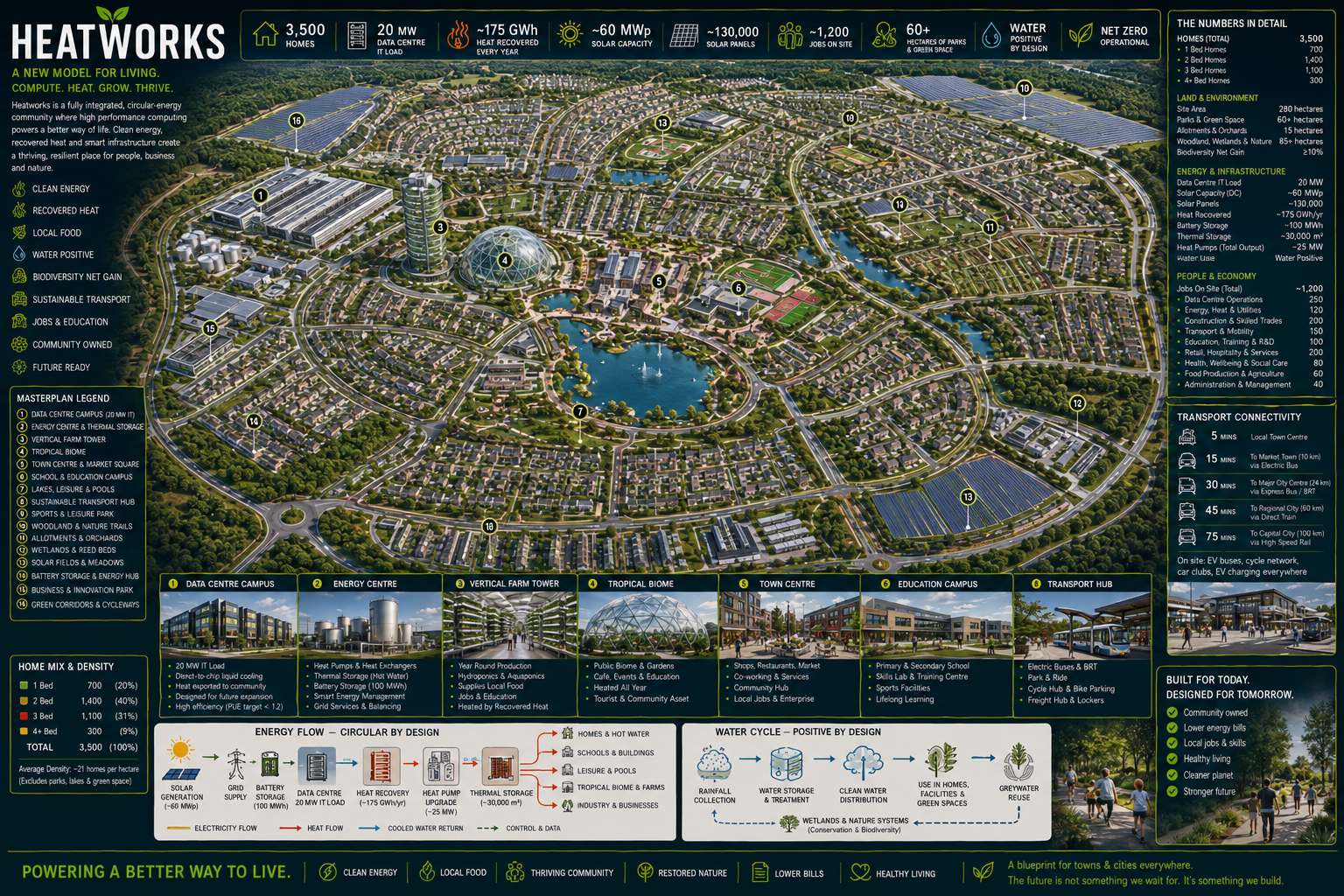
Our fictional masterplan combines 3,500 homes with a 20MW IT data centre, district heat, closed-loop liquid cooling, heat pumps, thermal storage, about 60MWp of solar, battery storage, a vertical farm, leisure facilities, schools, wetlands, public transport and large areas of green space.
The concept deliberately pushes integration toward an optimistic extreme. The useful question is not whether the picture looks appealing; it is whether the engineering, economics and seasonal energy flows survive scrutiny.
Could Heatworks actually heat 3,500 homes?
Potentially, but not by simply dividing 175GWh by the annual heating demand of a house. The servers create heat continuously while household space-heating demand changes dramatically with weather and season.
A plausible system would need heat pumps, thermal storage and several kinds of customer: homes, hot water, leisure pools, schools, businesses, food production and perhaps industry. Winter is comparatively straightforward because heating demand is high.
Summer is harder. Domestic hot water continues, but space heating collapses while the computers still produce heat. Swimming pools, greenhouses, industry and storage can absorb some of it, but if there is insufficient demand the site still needs conventional heat rejection. Any real project should therefore answer a deceptively simple question: what happens to the heat in August?
What about the vertical farm?
Controlled-environment agriculture could use recovered heat and recirculated water while producing food close to consumers. But vertical farming can also consume substantial electricity, particularly where crops depend heavily on artificial lighting.
Recovered heat does not make those electricity costs disappear. A real feasibility study might conclude that a daylight-heavy greenhouse, ordinary glasshouse or a completely different industrial heat customer makes more sense than a tower. The visual appeal of an idea is not evidence of its economics.
Can all those solar panels power the data centre?
Not continuously. Heatworks includes about 60MWp of solar capacity across rooftops, car parks and surrounding land. That could produce a large amount of electricity over a year, but annual generation and continuous power are different things.
Solar output disappears at night and falls sharply in a British winter. Batteries can move energy between hours but ordinary short-duration batteries cannot economically turn a summer surplus into months of winter supply at this scale.
Heatworks therefore remains grid connected. Solar can reduce imports and contribute materially to annual electricity demand; it does not make a 20MW data centre an energy island. Wind or long-term power agreements could complement solar, but “100% renewable” claims should still distinguish annual accounting from the electricity physically available each hour.
Would Heatworks really create 1,200 jobs?
The 1,200 figure on our concept image is a whole-community scenario, not a claim that a 20MW data centre would employ 1,200 people.
Data centres are highly automated. The House of Commons Library highlights a proposed £10 billion Blyth campus that could contain up to ten data centres yet is expected to directly create around 400 permanent full-time on-site jobs.
A Heatworks-style settlement would need to earn its employment claim across the wider ecosystem — data-centre operations, energy, horticulture, education, healthcare, transport, leisure, retail, maintenance and local businesses — and construction jobs should always be reported separately from permanent jobs.
Transport: the part that should not be an afterthought
A supposedly sustainable new community makes little sense if thousands of residents must drive elsewhere every morning. Heatworks therefore assumes a strong connection to an existing town or city, potentially by rail where geography allows or by rapid electric bus where it does not.
That raises a wider planning question for real AI infrastructure: should major data-centre proposals be assessed not only against land, fibre, water and electricity, but also against housing, public transport and whether the development actually improves the place around it?
“Water positive” sounds good. Is it realistic?
Heatworks imagines rainwater capture, sustainable drainage, wetlands, greywater recycling and low-water closed-loop cooling. Those measures could reduce demand on potable supplies, but they do not create water from nothing.
A serious project should publish actual numbers: potable water withdrawn, water consumed, water discharged, rainwater captured, water recycled and peak drought demand. “Water positive” without a defined accounting method would be a marketing phrase rather than useful evidence.
What the Green Party is actually proposing
The party's position is more nuanced than “ban data centres”. It is calling for the government to “slam the brakes” on proliferation, immediately end blanket designation of new data centres as critical infrastructure, tighten planning rules and require the highest environmental standards plus full community consultation.
Its proposed national AI-infrastructure strategy includes brownfield sites close to renewable-energy hubs, audited annual reporting of water and electricity, less water-intensive cooling, energy efficiency and technology to capture and redirect waste heat.
It also calls for greater UK digital sovereignty. The disagreement is therefore not simply “data centres or no data centres”; it is about pace, ownership, resource priority and how demanding the conditions should be.
What the government is actually proposing
The government's position is effectively the opposite on pace. It wants substantial domestic AI infrastructure and argues that onshore capacity protects sensitive data, improves resilience and helps Britain capture more of the economic opportunity from AI.
Its AI Growth Zone programme is designed to overcome planning and grid-connection barriers. It also tries to steer projects toward places where new electricity demand could make better use of the energy system, and promises local skills and business-rate benefits.
Government enthusiasm does not eliminate environmental constraints. Growth Zone proposals still have to confront land, water, power, planning and connectivity, while the Environment Agency says better transparency on actual water consumption is needed to model future demand reliably.
What industry says — and where the claim needs care
The industry's strongest argument is that digital infrastructure is no longer optional. Banking, healthcare, cloud services, public services and communications depend on it, and AI is adding another class of workload.
That wider economic dependence is real, but it should not be confused with the direct employment created by an individual server campus. Data centres can be strategically important and still employ relatively few people for the capital and electricity they consume.
The same caution applies to renewable-energy claims. Buying enough renewable power over a year is not necessarily the same thing as consuming renewable electricity every hour. The details of location, generation, grid constraints and contractual arrangements matter.
Would rejecting them simply move the problem abroad?
Sometimes. Computing workloads can cross borders more easily than factories. If British demand keeps rising while domestic capacity is restricted, some computation and investment could move elsewhere.
Whether that is environmentally better or worse depends on the alternative. A low-water facility supplied by low-carbon electricity abroad could perform better. A fossil-heavy, water-intensive facility could perform worse. “Build it here” and “build it abroad” are not environmental conclusions by themselves; the relevant comparison is between actual facilities.
What should a new data centre have to prove?
The case each way
Britain already depends on digital infrastructure and that dependence will increase as AI spreads through the economy. Restricting domestic capacity would not necessarily reduce global demand for computation; it could instead transfer investment, strategic capability and some workloads overseas.
The strongest version of this argument is not that data centres have no environmental cost. It is that the impacts can be reduced substantially through location, engineering, low-water cooling, cleaner electricity and useful heat recovery — and that stopping development rather than improving it could damage Britain's economic and strategic interests.
The expected scale of growth creates legitimate infrastructure risks. Electricity demand is rising, grid capacity is constrained, some facilities can consume significant water, and construction can lock in resource use for decades.
The strongest version of this argument is not that Britain should abandon computing. It is that highly resource-intensive projects should only proceed once power, water, carbon, land and community impacts are demonstrably manageable — rather than relying on promises that may be difficult to enforce after construction.
What remains uncertain
Nobody knows exactly how much computing AI will require in 2030, how quickly hardware and software efficiency will improve, or precisely how Britain's electricity system will evolve.
Even current measurement is incomplete. The Environment Agency says barriers to obtaining data-centre water-consumption information prevent accurate modelling of future needs. Forecasts are useful scenarios, not destiny.
Frequently asked questions
Does every data centre consume huge quantities of water?
No. Water use varies substantially according to cooling technology, climate and operating conditions. Evaporative systems can consume significant water, while closed-loop and direct-to-chip systems can greatly reduce direct water consumption.
Does AI actually use water?
Indirectly, yes. Computers generate heat and some facilities use water to remove it. Electricity generation can also carry an indirect water footprint. But assigning one fixed amount of water to every AI prompt is misleading because infrastructure and conditions vary.
Where does evaporated cooling water go?
Into the atmosphere as water vapour. It remains within the global water cycle, but it has been removed from the immediate local water resource and may return as precipitation somewhere else.
How much UK electricity do data centres use?
The House of Commons Library says data centres currently consume around 2.5% of UK electricity and cites projections that sector electricity consumption could rise four-fold by 2030.
Does all the electricity become heat?
Almost all electricity used by IT equipment ultimately becomes heat. Facility-wide energy also powers pumps, cooling and other equipment, which also dissipate energy.
Could that heat really warm houses?
Yes, under the right conditions. A government-backed scheme at Old Oak and Park Royal in London is intended to recover data-centre waste heat for thousands of homes, businesses and a hospital. Distance, temperature and heat-network economics remain important constraints.
Can solar panels power a data centre?
They can contribute substantially, but a large UK data centre normally needs continuous power at night and through winter. Solar therefore has to be combined with the grid, storage and/or other generation.
Do data centres create lots of jobs?
Construction can create substantial employment, but permanent operational staffing can be modest because data centres are highly automated. Parliament highlights a £10 billion Blyth campus expected to create around 400 permanent full-time on-site jobs.
Does the Green Party want to ban data centres?
No. Its 28 August 2026 proposal calls for the government to "slam the brakes" on proliferation, end blanket CNI designation for new data centres, tighten planning conditions and require stronger environmental standards and community consultation. It also supports greater UK digital sovereignty.
Does Critical National Infrastructure status automatically give data centres water before households?
NewsDeck could not establish that from the government's published explanation of the designation. Government describes CNI status primarily in security and resilience terms, while DEFRA says water companies may refuse cooling-water connections where resources are insufficient.
What is an AI Growth Zone?
It is a UK government programme intended to accelerate large-scale AI infrastructure by addressing planning and electricity-connection barriers while seeking local investment, skills and economic benefits.
Is Heatworks a real development?
No. Heatworks is a NewsDeck thought experiment. Its 3,500 homes, 20MW data centre, solar installation and employment figures are illustrative assumptions used to test what a highly integrated development might look like.
Sources & further reading (12)
- House of Commons Library — Data centres: planning policy, sustainability, and resilience (27 May 2026)
- Green Party — Call to “slam the brakes” on new data centre approval (28 August 2026)
- GOV.UK — Delivering AI Growth Zones
- GOV.UK — AI Growth Zones collection
- Environment Agency / GOV.UK — National Framework for Water Resources 2025: data centres
- UK Parliament — Written answer on data centres and local water resources (15 July 2026)
- Ofgem — Tackling speculative data-centre projects in the grid queue (29 July 2026)
- GOV.UK — Data centres designated Critical National Infrastructure (12 September 2024)
- GOV.UK — Waste heat from data centres to warm thousands of homes (3 November 2023)
- London City Hall / OPDC — Energy centre to reclaim waste heat from nearby data centres
- London City Hall / OPDC — Hemiko appointed for Old Oak and Park Royal heat network
- GOV.UK — Cyber security and resilience factsheet: data centres